
June 5, 2026 7:21 am
Welcome to the Hidden Valley HOA
Klamath Falls, OR
KLAMATH FALLS Weather
HOA President:
Kurt Martin
(541) 331-3030
Hidden Valley HOA CC&Rs
Updated: 9/8/2025
ARTICLE 1
DEFINITIONS
1.1 Architectural Review Committee or “ARC” shall refer to that committee constituted and acting pursuant to Article 6 of this Declaration.
1.2 Articles shall mean the Articles of Incorporation for the nonprofit corporation, Hidden Valley Homeowners’ Association, as filed with the Oregon Secretary of State.
1.3 Association shall mean and refer to Hidden Valley Homeowners’ Association, its successors and assigns.
1.4 Board shall mean the Board of Directors of the Association.
1.5 Bylaws shall mean and refer to the Bylaws of the Association, which shall be recorded in the Klamath County, Oregon, deed records.
1.6 Common Area shall mean and refer to Common Area A. Common Area A contains is a water d˄Retention pond to be owned by the Association. The Association shall maintain the pond and adjoining property within Common Area A.
1.7 Commonly Maintained Property shall mean and refer to the d˄Retention pond and storm drains which are intended to be devoted to the common benefit of the members and which improvements will be conveyed to the Association.
1.8 Declaration shall mean the covenants, conditions, restrictions, and all other provisions set forth in this Declaration.
1.9 Declarant shall mean and refer to Dan Martin Construction, Inc., and the Declarant’s successors or assigns, or any successor or assign to all or the remainder of its interest in the Property.
1.10 D˄Retention Pond shall mean the pond located in Common Area A.
1.11 General Plan of Development shall mean Declarant’s general plan of development of the Property, as approved by appropriate governmental agencies, as may be amended from time to time.
1.12 Home shall mean and refer to any portion of a structure situated on a Lot and designed and intended for use and occupancy as a residence by a single family or household.
1.13 Lot shall mean and refer to each and any of Lots within Hidden Valley; provided, however, that Lot shall not include Common Areas.
1.14 Members shall mean and refer to the Owners of Lots in Hidden Valley
1.15 Оссupant shall mean and refer to the occupant of a Home, whether such person is an Owner, a lessee, or any other person authorized by the Owner to occupy the Home.
1.16 Owner shall mean and refer to the record owner, whether one or more persons or entities, of the fee simple title to any Lot or a purchaser in possession of a Lot under a land sale contract. The foregoing does not include persons or entities who hold an interest in any Lot merely as security for the performance of an obligation.
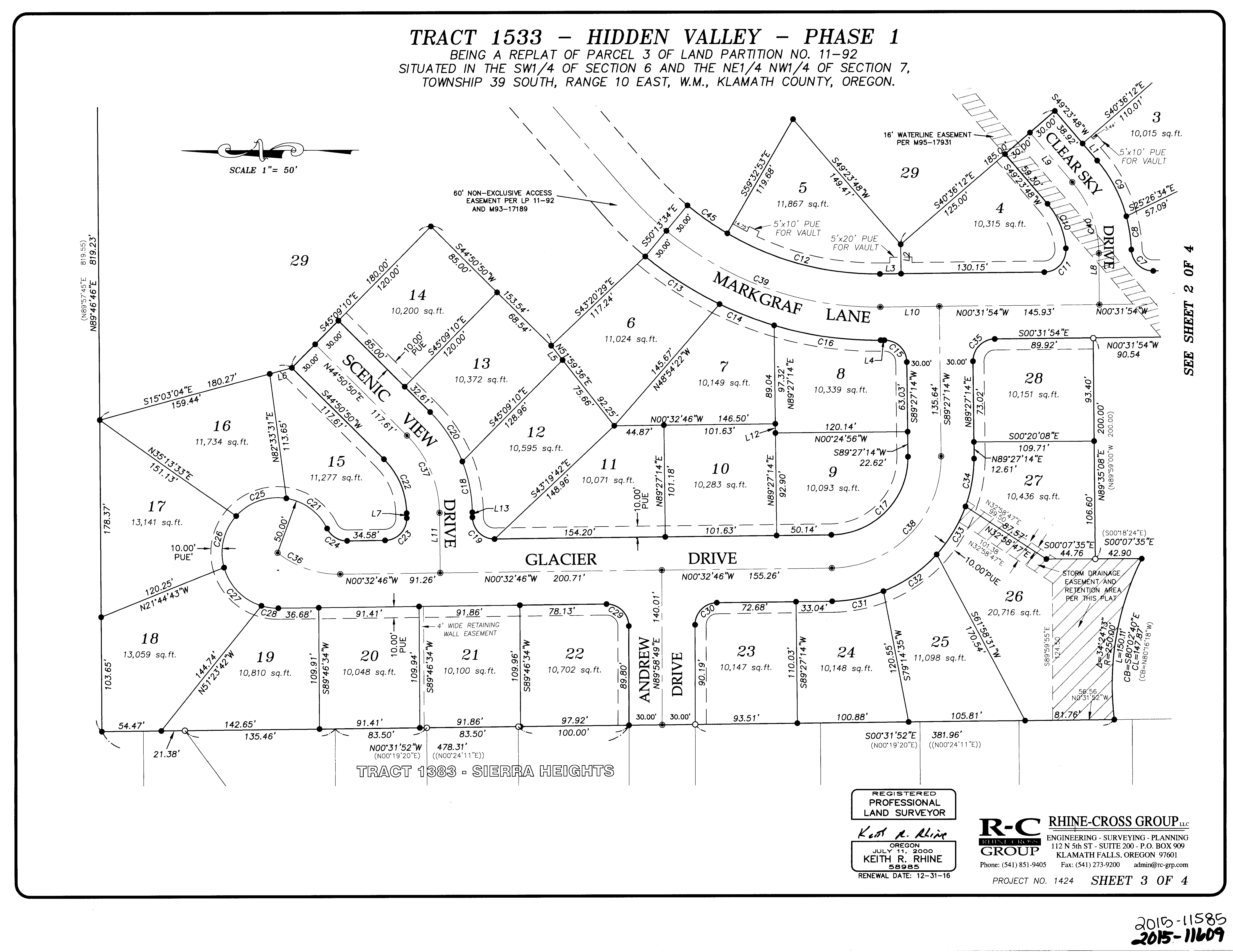
1.17 Plat shall mean and refer to the Plat of Tract #1533-Hidden Valley recorded with the Klamath County Clerk, Klamath Falls, Oregon, and all future phase plats.
1.18 Property shall have the meaning attributed to such term in the Recitals of this Declaration.
1.19 Reserve Account(s) shall mean and refer to an account set up by the Board to hold funds for construction, improvements or maintenance of the Common Area and the Commonly Maintained Property.
1.20 Rules and Regulations shall mean and refer to the documents containing rules and regulations and policies adopted by the Board or the Architectural Review Committee, as may be from time to time amended.
1.21 Storm drains shall mean and refer to the storm drains running to and from the d˄Retention pond located on Common Area A.
ARTICLE 2
PROPERTY SUBJECT TO THIS DECLARATION
2.1 Development. The development of Hidden Valley shall consist of the Property, which shall be held, transferred, sold, conveyed, and occupied subject to this Declaration. Declarant does not intend to build any Common Area improvements in Hidden Valley other than the d˄Retention pond and storm drains delineated on the Plat.
2.2 No Right to Annex Additional Property or to Withdraw Property. Declarant reserves no right to annex additional property to or to withdraw property from Hidden Valley, except for future phases of Hidden Valley proposed on Lot 29 of the Phase 1 plat.
ARTICLE 3
OWNERSHIP AND EASEMENTS
3.1 Non-severability. The interest of each Owner in the use and benefit of the Common Area Shall be appurtenant to the Lot owned by the Owner. No Lot shall be conveyed by the Owner separately from the interest in the Common Area. Any conveyance of any Lot shall automatically transfer the right to the benefit of the Common Area without the necessity of express reference in the instrument of conveyance. There shall be no judicial partition of the Common Area. Each Owner, whether by deed, gift, devise, or operation of law, for such Owner’s benefit and for the benefit of all other Owners, specifically waives and abandons all rights, interests, and causes of action for judicial partition of any interest in the Common Area and agrees that no action for judicial partition shall be instituted, prosecuted, or reduced to judgment. Ownership interests in the Common Area and Lots are subject to the easements granted and reserved in this Declaration. Each of the easements granted or reserved herein shall be deemed to be established upon the recordation of this Declaration and shall thenceforth be deemed to be covenants running with the land for the use and benefit of the Owners and their Lots.
3.2 Ownership of Lots. Title to each Lot in Hidden Valley shall be conveyed in fee to an Owner. If more than one person and /or entity owns an undivided interest in the same Lot, such persons and /or entities shall constitute one Owner.
3.3 Ownership of Common Area. Title to any Common Area shall be conveyed to the Association not later than the date of the Turnover Meeting.
3.4 Easements. Individual deeds to Lots may, but shall not be required to, set forth the easements specified in this Article.
3.4.1 Easements on Plat. The Common Area and Lots are subject to the easements and rights-of-way shown on the Plat.
3.4.2 Utility and Drainage Easements. Notwithstanding anything expressed or implied to the contrary, this Declaration shall be subject to all easements granted by Declarant for the installation and maintenance of utilities and drainage facilities necessary for the development of Hidden Valley. No structure, planting, or other material that may damage or interfere with the installation or maintenance of utilities, that may change the direction of flow of drainage channels in the easements, or that may obstruct or retard the flow of water through drainage channels in the easement areas shall be placed or permitted to remain within any easement area.
3.4.3 Association’s Easements. Declarant grants to the Association and its duly authorized agents and representatives such easements over the Lots and Common Area as are necessary to perform the duties and obligations of the Association, as set forth in this Declaration, the Bylaws, and the Articles, as the same may be amended.
3.4.4 Easement to Governmental Entities. Declarant grants a nonexclusive easement over the Common Area to all governmental and quasi-government entities, agencies, utilities, and their agents for the purposes of performing their duties as it relates to storm water.
3.4.5 Perimeter Easement Benefitting Association. Declarant grants to the Association and its duly authorized agents and representatives an easement over that perimeter portion of each Lot that is included within the building setbacks set by applicable ordinances for the purposes of installation, maintenance, repair, and replacement of utilities, communication lines, and drainage. The Board may grant or convey the easements reserved herein to any governmental body or agency and/or any public or private utility company or provider, on a two thirds vote of the Board members at a duly called and held Board meeting.
ARTICLE 4
LOTS AND HOMES
4.1 Maintenance of Lots and Homes. Each Owner shall maintain such Owner’s Lot and all improvements thereon in a clean and attractive condition, in good repair, and in such fashion as not to create a fire hazard. Such maintenance shall include, without limitation, maintenance of windows, doors, garage doors, walks, patios, chimneys, and other exterior improvements and glass surfaces. Each Owner shall repair damage caused to such Owner’s Lot or improvements located thereon by fire, flood, storm, earthquake, riot, vandalism, or other causes within a reasonable period.
4.2 Animals. No animals, livestock, or poultry of any kind, other than a reasonable number of household pets that are not kept, bred, or raised for commercial purposes and that are reasonably controlled so as not to be a nuisance, shall be raised, bred, kept or permitted within any Lot. Owners whose pets cause any inconvenience or unpleasantness to other Owners shall take all steps reasonably necessary to prevent recurrence thereof and Owners whose pets damage other Owners’ Lots or personal property shall reimburse such other Owners for reasonable costs actually incurred by such other Owners in repairing such damage. An Owner shall ensure that such Owner’s dog is leashed when on the Property and outside of such Owner’s Lot. An Owner may be required to remove a pet on the receipt of the third notice in writing from the Board of a violation of any rule, regulation, or restriction governing pets within the Property.
4.3 Nuisance. No noxious, harmful, or offensive activities shall be carried out on any Lot or Common Area.
4.4 Vehicles in Disrepair. No Owner shall permit any vehicle that is in a state of disrepair or that is not currently licensed to be abandoned or to remain parked on the Common Area or on any street on or adjacent to the Property at any time and may not permit them on a Lot for a period in excess of 48 hours. A vehicle shall be deemed in a “state of disrepair” when the Board reasonably determines that its presence offends the occupants or the neighborhood. If an Owner fails to remove such vehicle within five days following the date on which the Association mails or delivers to such Owner a notice directing such removal, the Association may have the vehicle removed from the Property and charge the expense of such removal to the Owner as a Reimbursement Assessment, which may be collected and enforced as any other assessments imposed pursuant to the Declaration and Bylaws.
4.5 Rubbish and Trash. No Lot or part of the Common Area shall be used as a dumping ground for trash or rubbish of any kind. All garbage and other waste shall be kept in appropriate containers for proper disposal and out of public view. Yard rakings, dirt, and other material resulting from landscaping work shall not be dumped onto streets, the Common Area, or any other Lots. If an Owner fails to remove any trash, rubbish, garbage, yard raking’s, or any similar materials from any Lot, any streets, or the Common Area were deposited by such Owner or the Occupants of such Owner’s Lot after notice has been given by the Board to the Owner, the Association may have such materials removed and charge the expense of such removal to the Owner. Such charge shall constitute a Reimbursement Assessment, which may be collected and enforced as any other assessments imposed pursuant to the Declaration and Bylaws.
4.5.1 Community Burn Pile. The community burn pile has been added to areas exempted to 4.5
4.6 Service Facilities. Service facilities (garbage containers, fuel tanks, clotheslines, etc.) shall be screened so that such facilities are not visible at any time from the street or a neighboring property. All telephone, electrical, cable television, and other utility installations shall be placed underground in conformance with applicable law and subject to approval by the ARC.
4.7 Exterior Lighting or Noise-making Devices. Except with the consent of the ARC, no exterior lighting or noise-making devices, other than security and fire alarms, shall be installed or maintained on any Lot.
4.8 Right of Maintenance and Entry by Association. If an Owner fails to perform maintenance and/or repair that such Owner is obligated to perform pursuant to this Declaration, and if the Board determines, after notice, that such maintenance and/or repair is necessary to preserve the attractiveness, quality, nature, and/or value of Hidden Valley the Board may cause such maintenance and/or repair to be performed and may enter any such Lot whenever entry is necessary in connection with the performance thereof. An Owner may request, and the Board shall conduct, a hearing on the matter. The Owner’s request shall be in writing delivered within five days after receipt of the notice, and the hearing shall be conducted within not less than five days nor more than 20 days after the request for a hearing is received. Entry shall be made with as little inconvenience to an Owner as practicable and only after advance written notice of not less than 48 hours, except in emergency situations. The costs of such maintenance and/or repair shall be chargeable to the Owner of the Lot as a Reimbursement Assessment, which may be collected and enforced as any other assessments authorized hereunder.
4.9 Association Rules and Regulations. The Board from time to time may adopt, modify, or revoke such Rules and Regulations governing the conduct of persons and the operation and use of Lots and the Common Area as it may deem necessary or appropriate to assure the peaceful and orderly use and enjoyment of the Property and the administration and operation of the Association. A copy of the Rules and Regulations, upon adoption, and a copy of each amendment, modification, or revocation thereof, shall be delivered by the Board promptly to each Owner and shall be binding upon all Owners and occupants of all Lots on the date of delivery or actual notice thereof. The method of adoption of such Rules and Regulations shall be provided in the Bylaws of the Association. Subject to the Board’s approval or consent, the ARC may adopt rules and regulations pertinent to its functions.
4.10 Ordinances and Regulations. The standards and restrictions set forth in this Article 4 shall be the minimum required. To the extent that local governmental ordinances and regulations are more restrictive or provide for a higher or different standard, such local governmental ordinances and regulations shall prevail.
4.11 Temporary Structures. No structure of a temporary character or any trailer, basement, tent shack, garage, barn, or other outbuilding shall be used on any Lot as a residence, either temporarily or permanently.
4.12 On street Parking. On street parking of vehicles is allowed but limited to daily use of normal homeowner behavior. Neighbors shall not park in front of other neighbors without consent for longer than 24 hours. Neighbor parking shall only be used when a home owners typical parking areas have already been used. Purposeful parking as a nuisance will not be allowed within the 24-hour scope. No trailers of any kind are allowed within street parking except for loading and unloading. Parking within 15’ of a fire hydrant is prohibited. Homes on corner lots are prohibited from blocking sightlines for traffic safety. Trailer parking to be limited to behind curb of sidewalk only. No excess trailer parking will be allowed between curb and fence. Parking is limited to one trailer that is beyond the front of a home. No blocking of sidewalks. Additional parking or modification of parking rules may be allowed after a written request to the board. Parking penalties will be doubled for each violation in a calendar year. First parking violation fine: $500. Each vehicle as well each incident will be fined individually.
4.13 Fines collected. All fines collected will reduce the following yearly HOA dues for all lots, excluding lots with violations. If fines exceed all yearly HOA dues, the remainder will be carried into the following year.
4.14 Lots with unpaid dues/fines. Lots with unpaid dues and fines lose HOA privileges, included but not limited HOA voting rights, attending rights and requests.
4.15 Rental Agreements. No short-term rentals (Air B&B, Vrbo) are allowed. 1 Month minimum rental agreements are required. Homeowner is responsible for any renter related activity.
ARTICLE 5
COMMON AREA
5.1 Use of Common Areas. Use of the Common Area is subject to the provisions of the Declaration, Bylaws, Articles, and the Rules and Regulations adopted by the Board. There shall be no obstruction of any part of the Common Area. Nothing shall be stored or kept in the Common Area without the prior written consent of the Board. The Association shall post “No Parking” signs on the Common Area.
5.2 Maintenance of Common Area. The Association shall be responsible for maintenance, repair, replacement, and upkeep of the Common Area and the private storm water infrastructure at the equal expense of the Owners all Lots. The Association shall keep the Common Area in good condition and repair, provide for all necessary services, and cause all acts to be done that may be necessary or proper to assure the maintenance of the Common Area.
5.3 Alterations to Common Area. Only the Association shall construct, reconstruct, or alter any improvement located on the Common Area.
5.4 Funding. Expenditures for alterations, maintenance, or repairs to an existing improvement for which a reserve has been collected shall be made from the Reserve Account. As provided in Section 10.5, the Board may levy a special assessment to fund any construction, alteration, repair, or maintenance of an improvement (or any other portions or the Common Area) for which no reserve has been collected or for which the Reserve Account is insufficient to cover the cost of the proposed improvement. Mailing, Printing and any/all court expenses will be paid out of the HOA account unless covered by insurance.
5.5 Landscaping. All landscaping on the Common Area shall be maintained and cared for in a manner that is consistent with Declarant’s or the ARC’s original approval of such landscaping. Weeds and diseased or dead lawn, tree, groundcover, or shrubs shall be removed and replaced.
5.6 Condemnation of Common Area. If all or any portion of the Common Area is taken for any public or quasi-public use under any statute, by right of eminent domain, or by purchase in lieu of eminent domain, the Board shall receive and expend the entire award in a manner that, in the Board’s discretion, is in the best interest of the Association and the Owners. The Association shall represent the interest of all Owners in any negotiations, suit, action, or settlement in connection with such matters.
5.7 Damage or Destruction of Common Area. If all or any portion of the common Area is damaged or destroyed by an Owner or any of Owner’s guests, Occupants, tenants, licensees, agents, or members of Owner’s family in a manner that would subject such Owner to liability for such damage under Oregon Law, such Owner hereby authorizes the Association to repair such damage. The Association shall repair the damage and restore the area in workmanlike manner as originally constituted or as may be modified or altered subsequently by the Association in the discretion of the Board. Reasonable costs incurred in connection with affecting such repairs shall become a special assessment on the Lot and against the Owner who caused or is responsible for such damage.
ARTICLE 6
ARCHITECTURAL REVIEW COMMITTEE
6.1 Architectural Review. No improvement including fences and signs larger than 1’x2’ shall be commenced, erected, placed, or altered on any Lot until the construction plans and specifications showing the nature, shape, heights, materials, colors, and proposed location of the improvement have been submitted to and approved in writing by the ARC. This Article’s purpose is to assure quality of workmanship and materials and harmony between exterior design and the existing improvements and landscaping and as to location with respect to topography and finished grade elevations. The ARC shall not be responsible for determining compliance with structural and building codes, solar ordinances, zoning codes, or other governmental regulations, all of which are the applicant’s responsibility. The procedure and specific requirements for review and approval of construction shall be set forth in design guidelines and standards adopted from time to time by the ARC. The provisions of this Article shall apply in all instances in which this Declaration requires the ARC’s consent. 6.2 Architectural Review Committee, Appointment and Removal. Declarant reserves the right to appoint all members of the ARC and all replacements thereto until Hidden Valley is 100% built out. The ARC shall consist of no fewer than three members and no more than five members. Each ARC member shall serve for one year. After build out, Declarant shall assign to the Board the right to appoint and remove members of the ARC. Board members and persons who are not Owners but who have special expertise regarding the matters that come before the ARC may serve as all or some of the ARC’s members. In the Board’s sole discretion, non-Owner members of the ARC may be paid. The Board may appoint itself as the ARC or any of its members to the ARC. If an ARC has not been appointed, the Board shall serve as the ARC.
6.2 Architectural Review Committee, Appointment and Removal. Declarant reserves the right to appoint all members of the ARC and all replacements thereto until Hidden Valley is 100% built out. The ARC shall consist of no fewer than three members and no more than five members. Each ARC member shall serve for one year. After build out, Declarant shall assign to the Board the right to appoint and remove members of the ARC. Board members and persons who are not Owners but who have special expertise regarding the matters that come before the ARC may serve as all or some of the ARC’s members. In the Board’s sole discretion, non-Owner members of the ARC may be paid. The Board may appoint itself as the ARC or any of its members to the ARC. If an ARC has not been appointed, the Board shall serve as the ARC.
6.3 Majority Action. Except as otherwise provided in this Declaration, a majority of the members of the ARC shall have the power to act on behalf of the ARC without the necessity of a meeting and without the necessity of consulting the remaining member or members of the ARC. The ARC may render its decision only by written instrument setting forth the action taken by the members consenting thereto.
6.4 Duties. The ARC shall consider and act on the proposals and/or plans submitted pursuant to this Article. The ARC, from time to time and at its sole discretion, may adopt architectural rules, regulations, and guidelines (“Architectural Standards”).
6.5 ARC Decision. The ARC shall render its written decision approving or denying each construction application submitted to it within 15 working days after its receipt of all materials required with respect to such application. If the ARC fails to render such written decision within 30 days of its receipt of all required materials or request an extension, the application shall be deemed approved. The ARC shall be entitled to request one or more extensions of time, not to exceed 45 days. In the event of such extension requests, if the ARC does not render a written decision within 15 days after the expiration of the extension(s), the application shall be deemed approved. Provided, however, the applicant may agree to further extensions to allow the applicant to complete or supplement the application.
6.6 ARC Discretion. The ARC, at its sole discretion, may withhold consent to any proposed work if the ARC finds the proposed work would be inappropriate for the particular Lot or incompatible with the design standards that the ARC intends for Hidden Valley. The ARC may consider siting, shape, size, color, design, height, solar access, or other effect on the use or enjoyment of other Lots or the Common Area, and any other factors that it reasonably believes to be relevant in determining whether or not to consent to any proposed work.
6.7 Non-waiver. Consent by the ARC to any matter proposed to it or within its jurisdiction shall not be deemed to constitute precedent or waiver impairing its right to withhold approval as to any similar matter thereafter proposed or submitted to it for consent.
6.8 Appeal. After Declarant has assigned the right to appoint ARC members to the Board pursuant to Section 6.2, any Owner adversely impacted by ARC action may appeal such action to the Board. Such appealing Owner shall submit to the Board a written notice of appeal, setting forth specific objections or mitigating circumstances justifying the appeal, within 10 days after the ARC’s action. The Board shall issue a final, conclusive decision within 45 days after receipt of such notice, and such decision shall be final and binding on the appealing Owner and the ARC. Provided, however, the Board shall make reasonable efforts to reach a decision within 20 days. If the Board is serving as the ARC, then such appeal shall be deemed a request for reconsideration.
6.9 Effective Period of Consent. The ARC’s consent to any proposed work shall automatically expire three months after issuance unless construction of the project has been commenced or the Owner has applied for and received an extension of time from the ARC.
6.10 Determination of Compliance. The ARC may inspect, from time to time, all work performed and determine whether it is in substantial compliance with the approval granted. If the ARC finds that the work was not performed in substantial conformance with the approval granted, or if the ARC finds that the approval required was not obtained, the ARC shall notify the Owner in writing of the noncompliance. The notice shall specify the particulars of noncompliance and shall require the Owner to remedy the noncompliance.
6.11 Noncompliance. If the ARC determines that an Owner has not constructed an improvement consistent with the specifications of an ARC approval or has constructed an improvement without obtaining ARC approval, sends a notice of noncompliance to such Owner, and such Owner fails to commence diligently remedying such noncompliance in accordance with such notice, then, effective at 5:00 p.m. on the third day after issuance of such notice, the ARC shall provide notice of a hearing to consider the Owner’s continuing noncompliance. The hearing shall be set not more than 30 days from the date on which the notice of noncompliance was issued. At the hearing, if the ARC finds that there is no valid reason for the continuing noncompliance, the ARC shall determine the estimated costs of achieving compliances and may issue a fine against the noncomplying Owner for such amount. The ARC also shall require the Owner to remedy such noncompliance within 10 days after the date of the ARC’s determination. If the Owner does not comply with the ARC’s ruling within such period or any extension thereof granted by the ARC, at its sole discretion, the ARC may remove the noncomplying improvement, remedy the noncompliance, and/or record a notice of noncompliance in the county deed records. The costs of any such action shall be assessed against the Owner as a Reimbursement Assessment either before or after any remedial action is taken.
6.12 Liability. Neither the ARC nor any member thereof shall be liable to any Owner, Occupant, or builder for any damage, loss, or prejudice suffered or claimed on account of any action or failure to act of the ARC or a member thereof, provided only that the ARC or the member has, in accordance with its or his or her actual knowledge, acted in good faith.
6.13 Estoppel Certificate. Within 15 working days after the ARC’s receipt of a written request from an Owner and the ARC’s receipt of payment of a reasonable fee fixed by the ARC to cover costs, the ARC shall provide such Owner with a certificate executed by the Chairperson or other authorized member of the ARC certifying with respect to any Lot owned by the Owner, that, as of the date thereof either (a) all improvements made or done upon such Lot comply with this Declaration, or (b) such improvements do not so comply, in which event, the certificate shall also identify the noncomplying improvements and set forth with particularity the nature of such noncompliance. The Owner and such Owner’s heirs, devisees, successors, and assigns shall be entitled to rely on the certificate with respect to the matters set forth therein. The certificate shall be conclusive as among Declarant, the ARC, the Association, all Owners, and all persons deriving any interest through any of them.
6.14 Fees. The ARC may charge applicants a reasonable application fee and additional costs incurred or expected to be incurred by the ARC to retain architects, attorneys, engineers, and other consultants to advise the ARC concerning any aspect of the applications and/or compliance with any appropriate architectural criteria or standards, including, without limitation, those pertinent to house sitting and height. Such fees shall be collectible as assessments pursuant to Article 10.
6.15 Declarant and Successor Exempt from ARC. The Declarant or a successor to all of the unsold Lots shall be exempt from the requirement to submit and have plans approved by the ARC. However, the Declarant and its successor shall not be exempt from the provisions of Article 4 of the Declaration.
ARTICLE 7
MEMBERSHIP IN THE ASSOCIATION
7.1 Members. Each Owner shall be a member of the Association. Membership in the Association shall be appurtenant to, and may not be separated from, ownership of any Lot. Transfer of ownership of a Lot shall automatically transfer membership in the Association. Without any other act or acknowledgment, Occupants and Owners shall be governed and controlled by this Declaration, the Articles, Bylaws, and the Rules and Regulations of the Association and any amendments thereof.
7.2 Proxy. Each Owner may cast such Owner’s vote in person, by written ballot, or pursuant to a proxy executed by such Owner. An Owner may not revoke a proxy given pursuant to this Section 7.2 except by actual notice of revocation to the person presiding over a meeting of the Association. A proxy shall not be valid if it is undated or purports to be revocable without notice. A proxy shall terminate one year after its date, unless the proxy specifies a shorter term.
7.3 Voting Rights. The Association shall have two classes of voting members:
7.3.1 Class A. Class A members shall be all Owners of Lots other than Declarant, and each Class A member shall be entitled to one vote for each Lot owned with respect to all matters on which Owners are entitled to vote.
7.3.2 Class B. The Class B member shall be Declarant, its successors, and its assigns. The Class B member shall have three votes for each Lot owned. The Class B membership shall cease and be converted to Class A membership on the earlier of the following dates (the “Termination Date”): (a) The date on which 75% of the total number of Lots in Hidden Valley have been sold and conveyed to Owners other than Declarant; and (b) The date on which Declarant elects in writing to terminate Class B membership. After the Termination date, each Owner, including Declarant, shall be entitled to one vote for each Lot owned with respect to all matters on which Owners are entitled to vote, and the total number of votes shall be equal to the total number of Lots subject to this Declaration, initially or through annexation. When more than one person or entity owns a Lot, the vote for such Lot may be cast as they shall determine, but in no event shall fractional voting be allowed. Fractional or split votes shall be disregarded, except for purposes of determining a quorum.
7.4 Procedure. All meetings of the Association, the Board, the ARC, and Association committees shall be conducted with such rules of order as may from time to time be adopted by the Board. Notwithstanding which rule of order is adopted, the President shall be entitled to vote on all matters, not merely to break a tie vote. A tie vote does not constitute a majority or approval of any motion or resolution.
ARTICLE 8
DECLARANT CONTROL
8.1 Interim Board and Officers. Declarant hereby reserves administrative control of the Association. Declarant, in its sole discretion, shall have the right to appoint and remove members of an interim board (the “Interim Board”), which shall manage the affairs of the Association and be invested with all powers and rights of the Board until the Turnover Meeting (as hereinafter defined). The Interim Board shall consist of from one to three members. Notwithstanding the provision of this Section 8.1, at the Turnover Meeting, at least one Director shall be elected by Owners other than Declarant, even if Declarant otherwise has voting power to elect all three Directors.
8.2 Turnover Meeting. Declarant shall call a meeting for the purposes of turning over administrative control of the Association from Declarant to the Class A members within 60 days of the earlier of the following dates:
8.2.1 Earliest Date. The date on which Lots representing 75% of the total number of votes (68) of all Lots in Hidden Valley Phases 1, 2, & 3 have been sold and conveyed to persons other than Declarant;
8.2.2 Optional Turnover. The date on which Declarant has elected in writing to terminate Class B membership. Declarant shall give notice of the Turnover Meeting to each Owner as provided in the Bylaws. If Declarant does not call the Turnover Meeting required under this Section the transitional advisory committee or any Owner may do so.
ARTICLE 9
DECLARANT’S SPECIAL
9.1 General. Until the Homes on all Lots on the Property have been constructed, fully completed, and sold, with respect to the Common Area and each Lot on the Property, Declarant shall have the special rights set forth in this Article 9.
9.2 Marketing Rights. Declarant shall have the right to maintain a sales office and model on one or more of the Lots that Declarant owns. Declarant and prospective purchasers and their agents shall have the right to use and occupy the sales office and models during reasonable hours any day of the week. Declarant may maintain a reasonable number of “For Sale” signs at reasonable locations on the Property, including, without limitation, on the Common Area.
9.3 Declarant Easements. Declarant reserves easements over the Property as more fully described in Sections 3.4 hereof.
9.4 Additional Improvements. Declarant does not agree to build any improvements not described in this Declaration.
ARTICLE 10
FUNDS AND ASSESSMENTS
10.1 Purpose of Assessments; Expenses. The assessments levied by the Association shall be used exclusively to promote the recreation, health, safety, aesthetics, and welfare of the Owners and Occupants of Hidden Valley, for the improvement, operation, and maintenance of the Common Area and the Commonly Maintained Property, for the administration and operation of the Association, and for property and liability insurance.
10.2 Covenants to Pay. Declarant and each Owner covenant and agree to pay the Association the assessments and any additional charges levied pursuant to this Declaration or the Bylaws. All assessments for operating expenses, repairs and replacement, and reserves shall be allocated among the Lots and their Owners as set forth in Section 10.4.2.
10.2.1 Funds Held in Trust. The assessments collected by the Association shall be held by the Association for and on behalf of each Owner and shall be used solely as set forth in Section 10.1. On the sale or transfer of any Lot, the Owner’s interest in such funds shall be deemed automatically transferred to the successor in interest to such Owner.
10.2.2 Offsets. No offsets against any assessment shall be permitted for any reason, including, without limitation, any claim that the Association is not properly discharging its duties.
10.2.3 Right to Profits. Association profits, if any, shall be the property of the Association and shall be contributed to the Current Operating Account.
10.3 Basis of Assessment; Commencement of Assessments. Declarant shall pay all common expenses of the Association until the Lots are assessed for common expenses. The amount and date of commencement of the initial annual assessment to Owners other than Declarant shall be determined by Declarant. In the sole and unfettered discretion of Declarant, Declarant may defer payment of reserves for a Lot until the Lot is conveyed to a third party. However, Declarant may not defer payment of accrued reserves beyond the date of the Turnover Meeting.
10.4 Annual Assessments. Annual assessments for each fiscal year shall be established when the Board approves the budget for that fiscal year. The initial annual assessment shall be determined by Declarant and shall be prorated on a monthly basis at the time of the closing of the first sale from Declarant. For proration purposes, any portion of a month shall count as a full month. Annual assessments shall be payable on a periodic bases, not more frequently than monthly, as determined by the Board. The fiscal year shall be the calendar year unless another year is adopted by vote of the Association members.
10.4.1 Budgeting. Each year the Board shall prepare, approve, and make available to each Member a pro forma operating statement (budget) containing (a) estimated revenue and expenses on an accrual basis; (b) the amount of the total cash reserves of the Association currently available for replacement or major repair of the Common Area and Commonly Maintained Property and for contingencies; (c) an itemized estimate for the remaining life of, and the methods of funding to defray repair, replacement, or additions to major components of such improvements as provided in Section 10.6.2; and (d) a general statement setting forth the procedures used by the Board in the calculation and establishment of reserves to defray the costs of repair, replacement, or additions to major components of the Common Area and the Commonly Maintained Property. Notwithstanding that budgeting shall be done on an accrual basis, the Association’s books shall be kept on a cash basis and the Association shall be a cash basis taxpayer, unless applicable governmental regulations require otherwise. For the first fiscal year, the budget shall be approved by the Board no later than the date on which annual assessments are scheduled to commence. Thereafter, the Board shall annually prepare and approve the budget and distribute a copy or summary thereof to each Member, together with written notice of the amount of the annual assessments to be levied against the Owner’s Lot, within 30 days after adoption of such budget.
10.4.2 Equal Allocation of Assessments. The total amount in the budget shall be charged equally against all Lots as annual assessments.
10.4.3 Non-waiver of Assessments. If before the expiration of any fiscal year the Association fails to fix annual assessments for the next fiscal year, the annual assessments established for the preceding year shall continue until a new annual assessment is fixed.
10.5 Special Assessments. The Board and /or the Owners shall have the power to levy special assessments against an Owner or all Owners in the following manner for the following purposes:
10.5.1 Correct Deficit. To correct a deficit in the operating budget, by vote of a majority of the Board;
10.5.2 Special Obligations of an Owner. To collect amounts due to the Association from an Owner for breach of the Owner’s obligations under this Declaration, the Bylaws, or the Rules and Regulations, by vote of a majority of the Board;
10.5.3. Repairs. To collect additional amounts necessary to make repairs or renovations to the Common Area or Commonly Maintained Property if sufficient funds are not available from the operating budget or replacement reserve accounts, by vote of a majority of the Board; or
10.5.4 Capital Improvements. To make capital acquisitions, additions or improvements, by vote of at least 80% of all votes allocated to the Lots.
10.5.5 Reimbursement Assessments. The Association shall levy a reimbursement assessment against any Owner and such Owner’s Lot if a failure to comply with this Declaration, Bylaws, Architectural Standards, or any Rules and Regulations has (a) necessitated an expenditure of monies by the Association to effect compliance or (b) resulted in the imposition of a fine or penalty against such Owner or such Owner’s Lot (a “Reimbursement Assessment”). A Reimbursement Assessment shall be due and payable to the Association when levied. A Reimbursement assessment shall not be levied by the Association except on at least 10 days’ written notice to the Owner being assessed. If, within said 10-day period, the Owner makes a written request to the Board for a hearing, a hearing shall be held. On request for a hearing, the Board shall conduct it not less than 10 nor more than 30 days after the request by the Owner, and shall make its decision within not more than 30 days after the hearing is held. If a notice has been previously given, and the hearing has already been held or waived (in writing or by the Owner’s failure to appear) for the violation resulting in the Reimbursement Assessment, no additional notice and hearing is required before levying the Reimbursement Assessment.
10.6 Accounts.
10.6.1 Туpes of Accounts. Assessments collected by the Association shall be deposited into at least two separate accounts with a bank, which accounts shall be clearly designated as (a) the Current Operating Account and (b) the Reserve Account. The Board shall deposit those portions of the assessments collected for current maintenance and operation into the Current Operating Account and shall deposit those portions of the assessments collected as reserves for replacement and deferred maintenance of capital improvements into the Reserve Account. Withdrawal of funds for the Association’s Reserve Account shall require the signatures of either two Directors or one Director and an officer of the Association who is not a Director. In its books and records, the Association shall account separately for operating expenses relating to the Common Area/Commonly Maintained Property and operating expenses relating to all other matters, as well as for necessary reserves relating to the Common Area/Commonly Maintained Property and necessary reserves relating to all other matters.
10.6.2 Reserve Account. Declarant shall establish a Reserve Account, in the name of the Association, which shall be kept separate from all other funds held by the Association. The Association shall pay out of the Reserve Account only those costs that are attributable to the maintenance, repair, or replacement of Common Area Property and Commonly Maintained Property that normally requires replacement, in whole or in part, within three to 30 years and not for regular or periodic maintenance and expenses. No funds collected for the Reserve Account may be used for ordinary current maintenance and operation purposes.
10.6.2.1 Calculation of reserve Assessment; Reserve Study. The Board of Directors of the Association shall annually conduct a reserve study, or review and update an existing study, of the Common Area and Commonly Maintained Property to determine the reserve account requirements. A reserve account shall be established for those items of the Common Area and Commonly Maintained Property all or part of which will normally require replacement in more than three and less than 30 years for the maintenance, repair, or replacement of items as may be required under the Declaration or Bylaws or that the Board of Directors, in its discretion, may deem appropriate. The reserve account need not include items that could reasonably be funded from operating assessments. The reserve study shall include: (a) identification of all items for which reserves are required to be established; (b) the estimated remaining useful life of each item as of the date of the reserve study; (c) the estimated cost of maintenance, repair or replacement of each item at the end of its useful life; and (d) a 30-year plan with regular and adequate contributions, adjusted by estimated inflation and interest earned on reserves, to meet the maintenance, repair and replacement schedule. The reserve account assessment shall be allocated pursuant to Section 10.4.2.
10.6.2.2 Loan from Reserve Account. After the Turnover Meeting described in Section 8.2, the Board may borrow funds from the Reserve Account to meet high seasonal demands on the Association’s regular operating fund or to meet unexpected increases in expenses. Funds borrowed must be repaid later from assessments if the Board has adopted a resolution, which may be an annual continuing resolution, authorizing the borrowing of funds. Not later than the adoption of the budget for the following year, the Board shall adopt by resolution written payment plan providing for repayment within a reasonable period.
10.6.2.3 Increase or Reduction, or Elimination of Reserve Account Assessment. At any time after the second year after the Turnover Meeting, future assessment for the Reserve Account may be increased or reduced by the vote of Owners of Lots representing 75% of the votes computed in accordance with Section 7.3.
10.6.2.4 Investment of Reserve Account. Nothing in this Section 10.6 prohibits the prudent investment of Reserve Account funds, subject to any constraints imposed by the Board, the Bylaws, or the Rules and Regulations.
10.6.2.5 Refunds of Assessments. Assessments paid into the Reserve Account are the property of the Association and are not refundable to sellers or Owners of Lots. Sellers or Owners of Lots may treat their outstanding share of the Reserve Account’s balance as a separate item in the sales contract providing for the conveyance of their Lot.
10.6.3 Current Operating Account. All costs other than those to be paid from the Reserve Account Pursuant to Section 10.5.2 may be paid from the Current Operating Account. 10.7 Default in Payment of Assessments, Enforcement o Liens.
10.7.1 Personal Obligation. All assessments properly imposed under this Declaration or the Bylaws shall be the joint and several personal obligations of all Owners of the Lot to which such assessment pertains. In a voluntary conveyance (i.e., one other than through foreclosure or a deed in lieu of foreclosure), the grantees shall be jointly and severally liable with the grantors for all Association assessments imposed through the recording date of the instrument effecting the conveyance. A suit for a money judgment may be initiated by the Association to recover such assessments without either waiving or foreclosing the Association’s lien.
10.7.2 Association Lien. The Association shall have a lien against each Lot for any assessment (of any type provided for by this Declaration or the Bylaws) or installment thereof that is delinquent. Such lien shall accumulate all future assessments or installments, interest, late fees, penalties, fines, attorney fees (whether or not suit or action is instituted), actual administrative costs, and other appropriate costs properly chargeable to an Owner by the Association, until such amounts are fully paid. Recording of the Declaration constitutes record notice and perfection of the lien. Said lien may be foreclosed at any time pursuant to the Planned Community Act. The Association shall record a notice of a claim of lien for assessments and other charges in the deed records of Klamath County, Oregon, before any suit to foreclose may be filed. The lien of the Association shall be superior to all other liens and encumbrances except property taxes and assessments, any first mortgage, deed of trust or land sale contract recorded before the Association’s notice of lien, and any mortgage or deed of trust granted to an institutional lender that is recorded before the Association’s notice of lien.
10.7.3 Interest; Fines; Late Fees; Penalties. The Board, in its reasonable discretion, may from time to time adopt resolutions to set the rate of interest and to impose late fees, fines, and penalties on delinquent assessments or for violations of the provisions or this Declaration, the Bylaws, Architectural Standards, and the Rules and Regulations adopted by the Board or the ARC. The adoption of such impositions shall be communicated to all Owners in writing not less than 30 days before the effective date by a notice mailed to the assessment billing address such Owners. Such impositions shall be considered assessments that are lien able and collectible in the same manner as any other assessments; provided, however, that fines or penalties for violation of this Declaration, the Bylaws, or any rule and regulation, other than late fees, fines, or interest arising from an Owner’s failure to pay regular, special, or reimbursement assessments may not be imposed against an Owner or such Owner’s Lot until such Owner is given an opportunity for a hearing as elsewhere provided herein.
10.7.4 Асceleration of Assessments. If an Owner is delinquent in payment of any assessment or installment on any assessment, the Association, on not less than 10 days’ written notice to the Owner, may accelerate the due date of the full annual assessment for that fiscal year and all future installments of any special assessments.
10.7.5 Association’s Right to Rents; Receiver. In any foreclosure suit by the Association with respect to such lien, the Association shall be entitled to collect reasonable rent from the defaulting Owner for the use of such Owner’s Lot or shall be entitled to the appointment of a receiver.
ARTICLE 11
GENERAL PROVISIONS 1
11.1 Records. The Board shall preserve and maintain minutes of the meetings of the Association, the Board and any committees. The Board also shall keep detailed and accurate financial records, including individual assessment accounts of Owners, the balance sheet, and income and expense statements. Individual assessment accounts shall designate the name and address of the Owner or Owners of the Lot, the amount of each assessment as it becomes due, the amounts paid on the account, and the balance due on the assessments. The minutes of the Association, the Board and Board committees, and the Association’s financial records shall be maintained in the State of Oregon and reasonably available for review and copying by the Owners. A reasonable charge may be imposed by the Association for providing copies.
11.2 Indemnification of Directors, Officers, Employees, and Agents. The Association shall indemnify any Director, officer, employee, or agent who was or is a party or is threatened to be made a party to any threatened, pending, or completed action, suit, or proceeding, whether civil, criminal, administrative, or investigative (other than an action by the Association) by reason of the fact that such person is or was a Director, officer, employee, or agent of the Association or is or was serving at the request of the Association as a Director, officer, employee, or agent of another corporation, partnership, joint venture, trust, or other enterprise, against expenses (including attorney fees),judgments, fines, and amounts paid in settlement actually and reasonably incurred by said person in connection with such suit, action, or proceeding if such person acted in good faith and in a manner that such person reasonably believed to be in, or not opposed to, the best interest of the Association, and, with respect to any criminal action or proceedings, had no reasonable cause to believe that such person’s conduct was unlawful. The termination of any action, suit, or proceeding by judgment, order, settlement, conviction, or with a plea of nolo contendere or its equivalent, shall not of itself create a presumption that a person did not act in good faith and in a manner that such person reasonably believed to be in, or not opposed to, the best interest of the Association, and, with respect to any criminal action or proceedings, had reasonable cause to believe that such person’s conduct was unlawful. Payment under this clause may be made during the pendency of such claim, action, suit, or proceeding as and when incurred, subject only to the right of the Association to reimbursement of such payment from such person, should it be proven at a later time that such person had no right to such payments. All persons who are ultimately held liable for their actions on behalf of the Association as a Director, officer, employee, or agent shall have a right of contribution over and against all other Directors, officers, employees, or agents and members of the Association who participated with or benefitted from the acts that created said liability.
11.3 Enforcement; Attorney Fees. The Association and the Owners and any mortgagee holding an interest on a Lot shall have the right to enforce all of the covenants, conditions, restrictions, reservations, easements, liens, and charges now or hereinafter imposed by any of the provisions of this Declaration as may appertain specifically to such parties or Owners by any proceeding at law or in equity. Failure by either the Association or by any Owner or mortgagee to enforce any covenant, condition, or restriction herein contained shall in no event be deemed a waiver of their right to do so thereafter. In the event suit or action is commenced to enforce the terms and provisions of this Declaration (including without limitations, for the collection of assessments), the prevailing party shall be entitled to its actual administrative costs incurred because of a matter or event that is the subject of the suit or action, attorney fees and costs in such suit or action to be fixed by the trial court, and in the event of an appeal, the cost of the appeal, together with reasonable attorney fees, to be set by the appellate court. In addition thereto, the Association shall be entitled to its reasonable attorney fees and costs incurred in any enforcement activity or to collect delinquent assessments, together with the Association’s actual administrative costs, whether or not suit or action is filed.
11.4 Severability. Invalidation of any one of these covenants, conditions, or restrictions by judgment or court order shall not affect the other provisions hereof and the same shall remain in full force and effect.
11.5 Duration. The covenants, conditions, and restrictions of this Declaration shall run with and bind the land for a term of 35 years from the date of this Declaration being recorded, after which time they shall be automatically extended for successive periods of 10 years, unless rescinded by a vote of at least 90% of the Owners.
11.6 Amendment. Except as otherwise provided in Section 11.5 or ORS 94.590, and the restrictions set forth elsewhere herein, this Declaration may be amended at any time by an instrument approved by not less than 75% of the total votes of each class of members that are eligible to vote. Any amendment must be executed, recorded, and certified as provided by law; provided, however, that no amendment of this Declaration shall effect an amendment of the Bylaws or Articles without compliance with the provisions of such documents, and the Oregon Nonprofit Corporation Act and that no amendment affecting the general plan of development or any other right of Declarant herein contained may be effected without the express written consent of Declarant or its successors and assigns, including, without limitation, amendment of this Section 11.6.
11.7 Release of Right of Control. Declarant may give up its right of control in writing at any time by notice to the association.
11.8 Unilateral Amendment by Declarant. In addition to all other special rights of Declarant provided in this Declaration, Declarant may amend this Declaration in order to comply with the requirements of the Federal Housing Administration of the United States, the Federal National Mortgage Association, the Government National Mortgage Association, the Federal Home Mortgage Loan Corporation, any department, bureau, board, commission, or agency of the United States or the State of Oregon, or any other state in which the Lots are marketed and sold, or any corporation wholly owned, directly or indirectly, by the United States or the State of Oregon, or such other state, the approval of which entity is required in order for it to insure, guarantee, or provide financing in connection with development of the Property and sale of Lots. Before the Turnover Meeting, no such amendment shall require notice to or approval by any Class A member.
11.9 Resolution of Document Conflicts. In the event of a conflict among any of the provisions in the documents governing Hidden Valley, such conflict shall be resolved by looking to the following documents in the order shown below: 1. Declaration; 2. Articles: 3. Bylaws; 4. Rules and Regulations.
Hidden Valley HOA By Laws
ARTICLE 1
PLAN OF LOT OWNERSHIP; DEFINITIONS
1.1 Bylaws Applicability. These Bylaws apply to the Lots and the Common Area in Hidden Valley Subdivision Phases 1-4, a planned community in Klamath County, Oregon, that have been subjected to the Declaration of Conditions, Covenants, and Restrictions of Dan Martin Construction, Inc. (the “Declaration”), as well as to the Hidden Valley Homeowners’
Association (the “Association”) and the entire management structure thereof.
1.2 Lots; Property. The Lots and the Common Area may be collectively referred to in these Bylaws as the “Property” or “Project” and the Lots individually as a “Lot” or collectively as the “Lots.”
1.3 Personal Application. All present or future Owners, tenants, Occupants, and their employees, and any other person that might occupy any portion of the Property in any manner, shall be subject to the provisions set forth in these Bylaws. The acquisition, rental, of occupancy of any of the Lots shall constitute acceptance and ratification of these Bylaws and agreement to comply with all the provisions hereof.
1.4 Definitions. Capitalized terms used but not defined herein shall have meanings attributed to them in Article 1 of the Declaration.
1.5 Oregon Planned Community Act. The Property, all Lots and Owners thereof, the Association and all Members thereof, shall be subject to the Oregon Planned Community Act, ORS 94.550 et seq. (the PCA).
ARTICLE 2
ASSOCIATION MEMBERSHIP, VOTING, MAJORITY OF OWNERS, QUORUM, PROXIES
2.1 Membership in the Association. Upon recordation of a conveyance or contract to convey a Lot, the grantee or purchaser named in such conveyance or contract shall automatically be and shall remain a Member of the Association until such time as such person’s ownership ceases for any reason. For all purposes of the Declaration and the administration of the Property, Lot ownership shall be determined from the records maintained by the Association. The record shall be established by the Owner filing with the Association a copy of the deed to or
land sale contract for such Owner’s Lot, to which shall be affixed the certificate of the recording officer of Klamath County, Oregon, showing the date and place of recording of such deed or contract. No person shall be recognized as an Owner unless a copy of the deed or contract has been filed with the Association as provide above showing such Owner to be the current Owner or contract purchaser of a Lot. Notwithstanding the foregoing, Declarant shall be the Owner of all previously unsold Lots, although no deed or land sale contract, with respect to such Lots, has been filed with the Association.
2.2 Voting Rights. The Association shall have two classes of voting Members:
2.2.1 Class A. Class A Members shall be all Owners of Lots other than Declarant, and each Class A Member shall be entitled to one vote for each Lot owned with respect to all matters on which Owners are entitled to vote.
2.2.2 Class B. The Class B Member shall be Declarant, its successors, and its assigns. The Class B Member shall have three votes for each Lot owned; provided, however, that Class B membership shall cease on the Termination Date, as defined in Section 3.3. After termination of Class B membership, each Owner (including Declarant) shall be entitled to one vote for each Lot owned with respect to all matters on which Owners are entitled to vote, and the total number of votes shall equal the total number of Lots annexed to the Property and subjected to these Bylaws.
When more than one person or entity owns a Lot, the vote for such Lot may be cast as they shall determine, but in no event shall fractional voting be allowed. Fractionalized or split votes shall be disregarded, except for purposes of determining a quorum.
2.3 Majority of Owners. As used in these Bylaws, the term majority shall mean those Owners holding over 50% of the voting rights allocated to the Owners in accordance with the Declaration and Section 2.2 above. Majority of Owners present shall mean Owners holding over 50% of the votes present at any legal meeting.
2.4 Quorum. Except as otherwise provided in these Bylaws, the presence in person or by proxy of Owners holding 50% or more of the outstanding votes in the Association, as defined in Section 2.2 of this Article, shall constitute a quorum.
2.5 Voting; Proxies. Owners may cast votes in person, by written ballot, or by proxy. Proxies must be filed with the Secretary of the Association (“Secretary”) before or during the appointed meeting. A proxy shall expire one year after the date it was signed unless a shorter period is specified in the proxy. The proxies may require the holder to cast a vote for or against any special proposal set out in the notice calling the meeting. Unless withdrawn, a proxy given to another person to vote at a specific meeting shall also be valid at an adjourned meeting called under the provisions of Section 3.8. The Association must retain proxies and ballots for one year from the date of the determination of the vote.
2.6 Authority to Vote. All Owners, including those who have leased their Lot to a third party, shall be entitled to vote. An Owner’s right to vote may not be revoked. A purchaser under a land sale contract entitled to immediate possession of the Lot shall be deemed the Owner thereof, unless otherwise provided in such contact.
2.7 Fiduciaries and Joint Owners. An executor, administrator, guardian, or trustee may vote, in person or by proxy, at any meeting of the Association with respect to any Lot owned or held by such person in such capacity, whether or not the same shall have been transferred to such person’s name, provided that such person has satisfied the Secretary that such person is the executor, administrator, guardian, or trustee holding such Lot in such capacity. Whenever any Lot is owned by two or more persons jointly according to the records of the Association, the vote of such Lot may be exercised by any one of the Owners then present, in the absence of protest by a co-owner. In the event of such protest, no one co-owner shall be entitled to vote without the approval of all co-owners. In the event of disagreement among the co owners, the vote of such Lot shall be disregarded for all purposes, except for determining whether a quorum is present.
ARTICLE 3
ADMINISTRATION
3.1 Association Responsibilities. The Owners shall constitute the Members of the Association, except as otherwise provided in the Declaration or these Bylaws, decisions and resolutions of the Association shall require approval by a majority of the Owners present at any legal meeting. A legal meeting is one duly called pursuant to these Bylaws at which a quorum is present, in person or by proxy at a formal gathering or, if a vote is taken by written ballots, when ballots are returned representing more than 50% of the vote, unless a larger vote is required to approve a ballot item, in which case the quorum requirements shall be the number of votes required to approve the proposal.
3.2 Place of Meetings. Formal meetings of the Association shall be held at suitable places convenient to the Owners as may be designated by the Board of Directors of the Association (the “Board”). If a vote is taken by written ballot, the Board shall count the returned written ballots within 48 hours of the ballot return deadline. Each Owner shall be notified by mail or other delivery of written notice of the results of the ballot meeting or that a quorum of ballots was not returned within 15 days after the ballot return deadline.
3.3 Turnover Meeting. Declarant shall call a meeting (which shall be the initial meeting) for the purpose of turning over administrative control of the Association from Declarant to the Members within 60 days after of the earliest of the following dates (the “Termination Date”).
3.3.1 Based on Lot Sales. The date on which 75% of the Lots in Hidden Valley have been sold and conveyed to Owners other than Declarant.
3.3.2 Earliest Date. The date on which Declarant delivers written notice to the Association of termination of Class B membership.
Declarant shall give notice of the Turnover Meeting to each Owner as provided in these Bylaws. If Declarant does not call such meeting as required under this Section 3, the transitional advisory committee or any Owner may do so.
At the Turnover Meeting, Declarant shall relinquish control of the administration of the Association and the Owners shall assume such control and shall elect the Board in accordance with the provisions of Article 4 of these Bylaws. Additionally, Declarant shall deliver to the Association all business and financial records, together with all Association bank accounts, funds and other assets as required by ORS 94.616. The turnover meeting may not be conducted by written ballot.
3.4 Annual Meetings. The Board, by a Board action, shall cause the first annual meeting of the Association to be held during the calendar year following the calendar year in which the Turnover Meeting is held. The Board, at its discretion, from time to time, may change the meeting date, provided that the meeting is held annually. At such meetings, the Owners shall elect new members of the Board in accordance with the requirements of Section 4.7 of these Bylaws to replace those Directors whose terms have expired. The Owners also may transact such other business of the Association as may properly come before them. Annual meetings of the Association may not be conducted by written ballot.
3.5 Special Meetings. The President shall call a special meeting of the Owners if so directed by a resolution of the Board or a petition, presented to the Secretary and signed by 30% or more of the Owners. All meetings called because of petition of Owners shall be held at a formal gathering, and not by written ballot, within 60 days after the Secretary’s receipt of the petition. The notice of any special meeting shall state the time and place of such meeting and the purpose thereof. No business other than that stated in such notice shall be transacted at a special meeting unless by consent of all the Owners of the Lots or as otherwise set out in these Bylaws.
3.6 Notice of Meetings. The Secretary shall mail a notice of each annual and special meeting, stating the purpose thereof and the time and place where such meeting is to be held, to each Owner of record at least 10 but not more than 50 days before such meeting or the date on which ballots for a ballot meeting are required to be returned. The Board of Directors may propose that the Owners take an action by written ballot without a meeting, pursuant to the provisions of the PCA and the Oregon Nonprofit Corporation Act. Such notices shall be mailed to the Owner’s address last given to the Secretary in writing by the Owner or such Owner’s vendee. If Lot ownership is split or the Lot has been sold on a contract, notice shall be sent to a single address, of which the Secretary has been notified in writing by such parties. If no address has been given to the Secretary in writing, then mailing to the Project Lot shall be sufficient. The mailing of a notice in the manner provided in this Section shall be considered notice served.
3.7 Adjourned Meetings. As permitted by ORS 65.214, if any gathering of Owners is not a legal meeting because a quorum has not attended, the Owners who are present, either in person or by proxy, may adjourn the meeting to a time not less than 48 hours nor more than 10 days from the time of the original meeting. The adjournment provisions of this Section 3.8 do not apply to actions proposed to be taken by written ballot.
3.8 Ballot Meetings. Unless prohibited or limited by the Articles of Incorporation of the Association, any action that may be taken at any annual or special meeting of the owners may be taken without a meeting if the Association delivers a written ballot to every owner entitled to vote on the matter as provided in ORS 94.647. Such ballot shall set forth each proposed action and provide an opportunity to vote for or against each proposed action. A proposed action shall be deemed to be approved by written ballot when the number of votes cast by ballot equals or exceeds any quorum required to be present at a meeting authorizing the action, and the number of approvals equals or exceeds the number of votes that would be required to approve the matter at a meeting at which the total number of votes cast was the same as the number of votes cast by ballot. The Board must provide owners with at least 10 days’ notice as required by ORS 94.647 (2)(b) before written ballots are mailed or otherwise delivered. If, at least three days before written ballots are scheduled to be mailed or otherwise distributed, at least 10% of the owners petition the Board requesting secrecy procedures, a written ballot must be accompanied by a secrecy envelope, a return identification envelope to be signed by the owner and instructions for making and returning the ballot. Written ballots that are returned in secrecy envelopes may not be examined or counted before the deadline for returning ballots has passed.
3.9 Order of Business. The order of business at all annual meetings shall be as follows:
(a) Roll Call.
(b) Proof of notice of meeting or waiver of notice.
(c) Reading of minutes of the preceding meeting.
(d) Reports of officers.
(e) Reports of committees.
(f) Election of inspectors of election.
(g) Election of Directors.
(h) Unfinished business.
(i) New business.
(j) Adjournment.
ARTICLE 4
BOARD OF DIRECTORS
4.1 Number and Qualification. The Board shall be composed of three persons, all of whom must be an Owner or a co-owner of a Lot; provided, however, that if a Lot is owned by more than one owner, only one owner of that Lot may serve on the Board of Directors at any one time. An officer or employee of a corporation, the trustee of a trust, the personal representative of an estate, or an employee of a trust or estate may serve on the Board if the corporation, trust, or estate owns a Lot.
4.2 Powers and Duties. The Board shall have the powers and duties necessary for the administration of the affairs of the Association and may do all such acts and things as are not by law or by these Bylaws directed to be done by the Owners.
4.3 Other Duties. In addition to duties imposed by these Bylaws or by resolutions of the Association, the Board shall have authority to carry out and be responsible for the following matters:
4.3.1 Upkeep of Common Area and Commonly Maintained Property. Care, upkeep, and supervision of the Common Area and the Commonly Maintained Property.
4.3.2 Reserves. Establishment and maintenance of replacement Reserve Accounts that The Board deems prudent for replacement of Common Area improvements or facilities and the Commonly Maintained Property.
4.3.3 Assessment Collection. Designation and collection of assessments from the Owners, in accordance with these Bylaws and the Declaration.
4.3.4 Budget; Voucher System. Establishment of a budget and payment of all common expenses of the Association and institution and maintenance of a voucher system for such payment, which shall require a sufficient number of signatories thereon as may be reasonably necessary to prevent any misuse of Association funds, in accordance with these Bylaws and the Declaration.
4.3.5 Insurance. Procurement and maintenance of insurance policies and payment of premiums therefor out of the common expense funds in respect to the Common Area, as more specifically provided in Article 8 of these Bylaws.
4.3.6 Personnel. Designation and dismissal of the personnel necessary for the maintenance and operation of the Project.
4.3.7 Financial Statements. Causing the preparation and distribution of annual financial statements of the Association to each of the Owners, as more specifically provided in the Declaration.
4.3.8 Rules. Adoption and amendment of administrative Rules and Regulations governing the details of operation and use of the Common Area and administration of the Association, including a fine schedule for violations of these Bylaws, the Declaration, or any rules or regulations promulgated thereunder. Provided, however, that any such Rules and Regulations shall always be subject to rescission or amendment by the Association on a majority vote of Owners present at any properly called meeting.
4.3.9 Copies of Documents; Bank Accounts. Causing the Association to comply with ORS 94.670 relating to maintenance within the state of Oregon of documents delivered to the Association by Declarant, depositing all assessments in a separate bank account in the name of the Association, payment of all expenses of the Association from the Association’s bank account, and maintenance and distribution of financial statements and to maintain copies suitable for duplication of the following: the Declaration, the Articles of Incorporation, the Bylaws, the Association rules and regulations and any amendments thereto, the most recent annual financial statement, and the current operating budget of the Association. Further, the Board of Directors shall cause to be maintained and kept current the information required to enable the Association to comply with ORS 94.670.
4.3.10 Tax Returns. Causing the Association to file the necessary tax returns of the Association.
4.3.11 Mailing Address. Establishing and maintaining a current mailing address for the Association.
4.3.12 Professional Services. Employment of legal, accounting, and other personnel or consultants for reasonable compensation to perform such services as may be required for the proper administration of the Association, and preparing and filing the required income tax returns or forms.
4.4 Limited Authority. The Board shall not take any of the following actions, except with the vote or written assent of a majority of the voting power of the Owners other than Declarant:
4.4.1 Third-Party Contracts. Enter into a contract with a third party wherein the third person will furnish goods or services for the Common Area, the Commonly Maintained Property, or the Association for a term longer than one year with the following exceptions:
(a) Management contract, the provisions of which have been approved by the Federal Housing Administration, U.S. Housing and Urban Development, or Department of Veterans Affairs.
(b) A contract with a public utility company in Klamath County, or a service contract if the rates charged for the materials or services are regulated by the Oregon Public Utilities Commission; provided, however, that the term of the contract shall not exceed the shortest term for which the supplier will contract at the regulated rate.
(c) A prepaid casualty and/or liability insurance policy the term of which does not exceed three years, provided that the policy permits short-rate cancellation by the insured.
4.4.2 Capital Expenditures. Incur aggregate expenditures for capital improvements (as opposed to maintenance, repair and replacement costs) to the Common Area, the Commonly Maintained Property, during any fiscal year in excess of 5% of the budgeted gross expenses of the Association for that fiscal year.
4.4.3 Compensating Board Members. Pay compensation to members of the Board or officers of the Association for services performed in the conduct of the Association’s business; provided, however, that the Board may cause a member or officer to be reimbursed for expenses incurred in carrying on the business of the Association.
4.5 Management Agent. The Board may employ a management agent, to be compensated in an amount established by the Board, to perform such duties and services as the Board shall authorize, including, but not limited to, the duties listed in Section 4.3 of these Bylaws.
4.6 Interim Board and Officers. Declarant hereby reserves administrative control of the Association until the Turnover Meeting. Declarant, in its sole discretion, may appoint and remove members of the Board and officers of the Association whose terms of service shall end on or before the date of the Turnover Meeting. However, at the Turnover Meeting, at least one Director shall be elected by Owners other than Declarant, even if Declarant otherwise has voting power to elect all three Directors.
4.7 Election and Term of Office. At the Turnover Meeting of the Association, the term of office of two Directors shall be fixed for two years. The term of office of one Director shall be fixed at one year. Should the number of Directors serving on the Board be increased, the same sequential election terms shall apply as nearly as is practicable. Upon expiration of the initial term of office of each respective Director, such Director’s successor shall be elected to serve a term of two years. The Directors shall hold office until their successors have been elected and hold their first meeting. At the Turnover Meeting, on agreement by vote of the Owners, the Owners may elect Directors by using a ballot that permits each Owner to vote for three nominees. In such event, the two nominees receiving the highest number of votes shall be the two year Directors and the nominee receiving the next highest number of votes shall be the one year Director.
4.8 Vacancies. Vacancies on the Board caused by any reason other than the removal of a Director by a vote of the Association shall be filled for the balance of the term of each directorship by vote of a majority of the remaining Directors, even though they may constitute less than a quorum. Each person so elected shall be a Director until a successor is elected upon expiration of the term for which such person was elected to serve by the other Directors.
4.9 Removal of Directors. At any legal annual or special meeting (not including actions proposed to be taken by written ballot without a meeting), any one or more of the Directors may be removed with or without cause, by a majority vote of the total voting power of the Owners and a successor may be then and there elected to fill the vacancy thus created; provided, however, that the notice of meeting shall specifically indicate that the removal of one or more named Directors is an agenda item for such meeting. Any Director whose removal has been proposed by the Owners shall be given an opportunity to be heard at such meeting.
4.10 Organizational Meeting. The first meeting of a newly elected Board shall be held within 10 days of election at such place as shall be fixed by the Directors at the Association meeting at which such Directors were elected, and no notice shall be necessary to the newly elected Directors in order to hold such meeting legally, providing a majority of the newly elected Directors are present.
4.11 Regular Meeting. Regular meetings of the Board may be held at such time and place as shall be determined, from time to time, by a majority of the Directors. Notice of regular meetings of the Board may be called by the President on at least three days’ notice to each Director, given personally or by mail, telephone, e-mail, or facsimile, which notice shall state the time, place (as hereinabove provided), and purpose of the meeting.
4.12 Special Meetings. Special meetings of the Board may be called by the President or Secretary or on the written request of at least two Directors. Special meetings of the Board may be called on at least three days’ notice to each Director, given personally or by mail, telephone, e-mail, or facsimile, which notice shall state the time, place (as hereinabove provided), and purpose of the meeting.
4.13 Waiver of Notice to Directors. Before, at, or after any meeting of the Board, any Director may, in writing, waive notice of such meeting and such waiver shall be deemed equivalent to the giving of such notice. Attendance by a Director at any meeting of the Board shall be a waiver of notice by such Director of the time and place thereof. If all the Directors are present at any meeting of the Board, no notice to Directors shall be required and any business may be transacted at such meeting.
4.14 Board of Directors’ Quorum. At all meetings of the Board, a majority of the existing Directors shall constitute a quorum for the transaction of business, and the acts of the majority of the Directors shall be the acts of the Board. If quorum requirements are not met at any meeting of the Board, the majority of those present may adjourn the meeting from time to time. At any such adjourned meeting, any business that might have been transacted at the meetings as originally called may be transacted without further notice.
4.15 Board Meetings Open to All Association Members. Except for executive sessions, all meetings of the Board shall be open to any and all Members of the Association; provided, however, that no Association Member shall have a right to participate in the Board’s meetings unless such Member is also a member of the Board. The President shall have authority to exclude any Association Member who disrupts the proceedings at a meeting of the Board. At the discretion of the Board, the following matters may be considered in executive session:
(a) consultation with legal counsel concerning rights and duties of the Association regarding existing or potential litigation or criminal matters;
(b) personnel matters, including salary negotiations and employee discipline;
(c) negotiations of contracts with third parties;
(d) collection of assessments; and
(e) for any other purpose permitted by the PCA.
Except in the case of an emergency, the Board shall vote in an open meeting whether to meet in executive session. If the Board votes to meet in executive session, the presiding officer of the Board shall state the general nature of the action to be considered, as precisely as possible, when and under what circumstances the deliberation can be disclosed to owners. The statement, motion, or decision to meet in executive session must be included in the minutes of the meeting. A contract or an action considered in executive session does not become effective unless the Board, following the executive session, reconvenes in open meeting and votes on the contract or action, which must be reasonably identified in the open meeting and included in the minutes.
4.16 Notice to Association Members of Board Meetings. For other than emergency meetings, notice of special Board meetings shall be mailed to each Owner at least seven days before the meeting by first-class mail or at least three days’ notice by hand-delivery to each Lot Owner’s address or by facsimile transmission. The Board shall give Owners notice of regular Board meetings at the beginning of each year by first class mail or other reasonable means setting out the time and place of the regular meetings. For any changed time or place, the notice requirements for special meetings shall apply.
4.17 Emergency Meetings. In the event of an emergency, Board of Directors meetings may be conducted by telephonic communication or by the use of a means of communication that allows all Board members participating to hear each other simultaneously or otherwise to be able to communicate during the meeting. No notice to either Directors or Association members shall be required for such meetings of the Board of Directors to be held for any emergency action. Provided, however, that no such meeting shall occur unless at least 75% of the Board of Directors participate in the same and after an attempt has been made to reach each Director.
4.18 Compensation of Directors. No Director shall be compensated in any manner, except for out-of-pocket expenses, unless such compensation is approved by vote of the Owners.
ARTICLE 5
OFFICERS
5.1 Designation. The principal officers of the Association shall be a President, a Secretary, and a Treasurer, all of whom shall be elected by the Directors. The Directors may appoint an assistant treasurer and an assistant secretary, and any such other officers as in their judgment may be necessary.
5.2 Election of Officers. The officers of the Association may be elected by the Board at the organizational meeting of each new Board or any Board meeting thereafter, and shall hold office at the pleasure of the Board.
5.3 Removal of Officers. Upon an affirmative vote of a majority of the Board, any officer may be removed, either with or without cause, and such officer’s successor may be elected at any regular or special meeting of the Board.
5.4 President. The President shall be the chief executive officer of the Association and shall preside at all meetings of the Association and of the Board. The President shall have all of the general powers and duties which are usually vested in the office of president of an association, including, but not limited to, the power to appoint committees from among the Owners from time to time as the President may, in the President’s discretion, decide is appropriate to assist in the conduct of the affairs of the Association.
5.5 Secretary. The Secretary shall keep the minutes of all meetings of the Board and the minutes of all meetings of the Association and shall have charge of such books and papers as the Board may direct; and shall, in general, perform all the duties incident of the office of secretary.
5.6 Treasurer. The Treasurer shall have responsibility for Association funds and securities not otherwise held by the managing agent and shall be responsible for keeping full and accurate accounts of all receipts and disbursements in books belonging to the Association. The Treasurer shall be responsible for the deposit of all monies and other valuable effects in the name, and to the credit, of the Association in such depositories as may from time to time be designated by the Board.
5.7 Directors as Officers. Any Director may be an officer of the Association.
ARTICLE 6
OBLIGATIONS OF THE OWNERS
6.1 Assessments. All Owners are obligated to pay assessments imposed by the Association to meet all the Association’s general common expenses, initially set at $120.00 per fiscal year. Assessment amounts can be periodically revised as discussed in the Declaration based on actual operating budget amounts. Assessments shall be payable on a periodic basis, not more frequently than monthly, as determined by the Board. Declarant (before turnover) and the Board (after turnover) may, but shall not be required to, impose interest or a service charge for late installment payments or allow a discount for payment of the annual assessment or any installment in advance.
6.2 Investment of Reserve Account Funds. Assessments paid into Reserve Accounts shall be kept with a safe and responsible depository, shall be accounted for separately, and, if invested, the obligation or security shall be fully guaranteed as to principal by the United States of America or one of its agencies. Assessments paid into the Reserve Accounts are the property of the Association and are not refundable to sellers of Lots. However, nothing contained herein shall prevent sellers of Lots from treating their outstanding allocable share of Reserve Accounts as a separate or reimbursable item in a sales agreement. No Owner shall have any individual rights in any of these reserves, although it is understood that the value of an Owner’s Lot may increase in proportion to such Lot’s right to receive repair, maintenance, and replacement therefrom.
6.3 Initial Assessment. The amount of the initial assessment due from Lot owners other than Declarant shall be determined by Declarant. The amount of the annual assessment thereafter shall be subject to review and modification by the Board of Directors.
6.3.1 Contribution to Working Capital. At closing of the sale of each Lot, each purchaser shall contribute to the Association a sum equal to one-sixth of the annual assessments, with respect to the Lot being purchased, as a one-time contribution to the working capital of the Association. Within 60 days after the first conveyance by the Declarant of the first Lot in Hidden Valley. Declarant shall make such contribution with respect to all Lots that have not yet been conveyed to a purchaser. If Declarant has made such contribution, no further contribution shall be required to the Association but each purchaser shall reimburse Declarant at closing for the amount of the contribution made by Declarant with respect to the Lot conveyed to the purchaser. If the amount of the assessments is reduced pursuant to the authority granted to Declarant herein, the initial deposit to the Association budget, equal to one-sixth of the annual assessment, shall be based on the projected amount of such annual assessments after substantial or full occupancy of the Lots rather than on the reduced amount. The working capital contribution shall be allocated to the general operating reserve referenced in Section 10.6.2.1 of the Declaration. The working capital contribution is in addition to regular assessments and shall not be used as a prepayment of assessments by any Owner. Declarant may not use the working capital funds to defray any of its expenses, reserve contributions, or construction costs, or to make up any budget deficits while Declarant is in control of the Association. All working capital contributions shall be disbursed to the Association at or prior to the turnover meeting and shall be credited to the operating reserve account.
6.3.2 Procedures. If Declarant or any other person pays all of the operating expenses of the Association or subsidizes such expenses, the assessment shall be reduced by such amount, but shall not be reduced to a sum less than the total amount of the replacement reserve items. With respect to Lots not yet conveyed by Declarant, Declarant may accrue the replacement reserve items. At the time of conveyance of the Lot for which the replacement reserve has been accrued, the accrued reserves must be paid to the Association.
Declarant or such other person paying all operating expenses or subsidizing such expenses, shall give 10 days’ written notice to individual Lot owners before their obligation to pay the full assessment begins. Thereafter, each owner, including Declarant or such other person, shall pay the assessments to the Association. In the event that Declarant has collected initial assessments from Lot purchasers at closing and thereafter elects to pay or subsidize the operating expenses, thereby causing the amount of the assessment to be reduced, the one-time initial contribution collected from Lot purchasers shall be held by Declarant in a separate Association account. On the date on which Lot owners are required to pay full assessments, the aggregate sums held in such separate account shall be deposited to the Association’s general account to be used as working capital.
6.3.3 Temporary Reduction of Assessment Amount. If the Association expenses are temporarily less than projected by Declarant because some or most of the Lots are not yet sold or occupied, Declarant shall have the authority to reduce temporarily the amount of the assessment to reflect the lower expenses of the project.
6.4 Income Tax Returns; Determination of Fiscal Year.
6.4.1 Fiscal Year. The fiscal year of the Association shall be the calendar year unless otherwise determined by the Board.
6.4.2 Tax Returns. The Board, in its sole discretion, shall determine the manner in which all necessary income tax returns are filed and of selecting any and all persons to prepare such tax returns.
6.5 Statement of Assessments.
6.5.1 The Association shall provide, within 10 business days of receipt of a written request from an owner, a written statement that provides:
6.5.1.1 The amount of assessments due from the owner and unpaid at the time the request was received, including:
(a) regular and special assessments;
(b) fines and other charges;
(c) accrued interest; and
(d) late payment charges.
6.5.1.2 The percentage rate at which interest accrues on assessments that are not paid when due.
6.5.1.3 The percentage rate used to calculate the charges for late payment or the amount of a fixed charge for late payment.
6.5.2 The Association is not required to comply with Section 6.5.1 if the Association has commenced litigation by filing a complaint against the owner and the litigation is pending when the statement would otherwise be due.
6.6 Default. Failure by an Owner to pay any assessment of the Association shall be a default by such Owner of such Owner’s obligations pursuant to these Bylaws and the Declaration. The Association shall be entitled to the remedies set forth in the Declaration.
6.7 Maintenance and Repair.
6.7.1 Lots. Except as otherwise specifically provided in the Declaration and these Bylaws, every Owner must promptly perform all maintenance and repair work to such Owner’s Lot and the exterior of the improvements thereon (which do not constitute Commonly Maintained Property) and keep the same in good repair and sanitary and neat condition.
6.7.2. Common Area and Commonly Maintained Property. The Association shall repair and maintain the Common Area and the Commonly Maintained Property, subject to the provisions of this document.
6.7.3 Reimbursement of Association. An Owner shall reimburse the Association for any expenditures incurred in repairing or replacing any portion of the Common Area or of any Commonly Maintained Property that was damaged through such Owner’s fault and that is not otherwise covered by insurance policies carried by the Owner or the Association for the Owner’s and the Association’s benefit. In such circumstances, the insurance obtained by the Owner shall be deemed to be the primary coverage. The Board of Directors shall have the unfettered discretion to refuse to make a claim on the Association’s policy even though coverage may pertain. Such discretion is for the purpose of maintaining the Association’s insurability and controlling the amount of the premiums for the Association’s insurance. Such charge shall be collectible as a Reimbursement Assessment as provided in the Declaration.
6.8 Right of Entry; Easements for Maintenance.
6.8.1 Emergencies. Present and future Owners, tenants, Occupants, and any other persons that occupy any portion of the Property, by virtue of acquisition, rental, or occupancy of any of the Lots, grant to the management agent or to any other person authorized by the Board or the Association the right to enter on such Lot in the event of an emergency originating in or threatening any Owner’s Lot.
6.8.2 Maintenance Easements. Declarant grants an easement to the Association in and through any Lot and the Common Area providing access at reasonable times and with reasonable notice for purposes of maintenance, repair, and replacement of the Common Area and Commonly Maintained Property, If, in performing such repair and maintenance, the Association needs to alter of damage any Lot, Commonly Maintained Property, or Common Area, it may do so without providing compensation, provided that it promptly restores the Lot and/or Common Area to substantially its prior condition.
ARTICLE 7
USE AND OCCUPANCY RESTRICTIONS; RULES OF CONDUCT
In addition to the restrictions and rules of conduct set forth in the Declaration, the following shall apply:
7.1 Use of the Common Area. No Owner shall place or cause to be placed on any portion of the Common Area any trash, structure, equipment, improvement, furniture, package, or object of any kind. Common areas shall be used for no purpose other than as a detention pond.
7.2 Appearance of Lots. Owners shall keep their Lots and the improvements thereon in good repair, clean, and with painted, stained, or other finished exteriors compatible with the Architectural Standards, the Declaration, and Rules and Regulations. Provided, however, the Association shall have such obligations with respect to the Commonly Maintained Property.
7.3 Nuisances. No Owner or Occupant shall cause or permit such Owner’s representatives, agents, employees, or family members to cause any nuisance or to make any use or engage in any practice on the Property that is a source of annoyance to other Owners and Occupants or that interferes with other Owners’ and Occupants’ peaceful possession and proper use of the Property. Owners and Occupants shall exercise extreme care about creating disturbances, making noises or using musical instruments, radios, televisions, and amplifiers that may disturb other Owners and Occupants. Owners and Occupants shall keep all parts of their respective Lots in a clean and sanitary condition, free of any accumulation of rubbish, refuse, or garbage and free of any fire hazard and shall not cause any accumulation of rubbish, refuse, or garbage or any fire hazard on any other part of the property. Owners and Occupants shall place all of their rubbish, refuse, and garbage inside disposal containers. No Owner shall make or permit any use of such Owner’s Lot or of the Common Area that will increase the cost of insurance on the Common Area.
7.4 Improper, Offensive, or unlawful Use. No Owner or Occupant shall make any improper, offensive, or unlawful use of any part of the Property. Owners and Occupants shall observe all valid laws, zoning ordinances, and regulations of governmental bodies having jurisdiction over the Property. The responsibility for meeting the requirements of governmental bodies for maintenance, modification, or repair of the Property shall be carried out and paid for in the same manner as the responsibility for the maintenance and repair of the Property concerned.
7.5 Additional Rules. In addition to the rules set forth in this Article 7, the Board may promulgate and amend, from time to time, Rules and Regulations concerning other use of the Property and shall furnish copies of such Rules and Regulations to any Owner or Occupant requesting such copies.
7.6 Enforcement. The Association, through its Board of Directors, shall have the power to enforce the covenants and restrictions in these Bylaws and in the Declaration. Owners shall also have the right to bring actions or suits regarding covenants and restrictions, but shall have no right or power to require the Association or Board of Directors to take any enforcement action.
7.7 Restriction on Exterior Installations. Except as permitted by law, no owner, resident, or tenant shall install wiring for electrical or telephone installation, machines, or air conditioning units or similar devices on the exterior of the building(s) or cause them to protrude through the walls or the roof of the building(s) except as authorized in writing by the Board of Directors, and, if the modification or installation would require an easement pursuant to the Declarations, then prior approval by the required percentage of owners. No window guards, awnings, or shades shall be installed without the prior written consent of the Board of Directors.
7.8 Fines. The Board of Directors may, after giving written notice and an opportunity to be heard, levy reasonable fines for violations of the Declaration, Bylaws, and Rules and Regulations of the Association, provided that fines levied are based on a schedule previously adopted by Board resolution that is mailed to the mailing address of each Unit or mailed to the mailing address designated in writing by the owner(s).
ARTICLE 8
INSURANCE
8.1 General. The Board shall obtain and maintain at all times insurance of the type and kind and in the amounts hereinafter provided and additional insurance for such other risks of a similar or dissimilar nature as are now or as shall be hereafter customarily covered by insurance obtained by other planned communities similar in construction and design. Such additional insurance shall be governed by this Article 8.
8.2 Types of Insurance Policies Maintained by the Association. For the benefit of the Association and the Owners, the Board shall obtain and maintain at all times, and shall pay for out of the common expense funds, the following insurance to the extent that it is available at reasonable cost.
8.2.1 Property Insurance. A policy or policies of property insurance, including, but not limited to, fire, extended coverage, vandalism, and malicious mischief, for the full insurable replacement value of the all substantial improvements on the Common Area to the extent such insurance is available and, if available at a reasonable cost, shall obtain building code and actual replacement cost endorsements and earthquake insurance.
8.2.2 Liability. A policy or policies insuring the Association, its Board, the Owners, individually, and the manager, against any liability to the public or the Owners and their invitees, or tenants, incident to the ownership, supervision, control, or use of the Property. Limits of liability under such insurance shall be not less than $1 million per occurrence for bodily injuries and property damage liability. Such limit and coverage shall be reviewed at least annually by the Board, which may increase the limit of and/or coverage, in its discretion. Said policy or policies shall be issued on a commercial General Liability form and shall provide cross-liability endorsements wherein the rights of the named insured under the policy or policies shall not be prejudiced as respects his, her, or their action against another named insured.
8.2.3 Workers’ Compensation. Workers’ compensation insurance, to the extent that it is necessary to comply with any applicable laws.
8.3 Fidelity Bond. For the benefit of the Association and Owners, the Board may obtain a fidelity bond naming such persons as may be designated by the Board as principals and the Association and the Owners as obliges, for the amount determined by the Board. The Board may pay for such bond out of the common expenses of the Association. In addition, the Board shall require that all officers and employees of the Association handling or responsible for Association funds to obtain adequate fidelity bonds and may pay for the premiums thereon.
8.4 Insurance Companies Authorized. All policies obtained under this Article 8 shall be written by a company licensed to do business in Oregon and holding a “Commissioner’s Rating” of “A+” and a size rating or “AAA” or better, by Best’s Insurance Reports, or as may be otherwise acceptable to all mortgagees and Directors.
8.5 Provisions in Insurance Policies. The Board shall make every reasonable effort to secure insurance policies that will provide for the following:
8.5.1 Waiver of Subrogation. A waiver of subrogation by the insurer as to any claims against the Board, the officers, the manager, the Owners and their respective servants, agents, guests, and tenants.
8.5.2 Non-cancellation for Owner Conduct. A provision that the master policy on the Property cannot be canceled, invalidated, or suspended on account of the conduct of any one or more individual Owners.
8.5.3 Non-cancellation Without Opportunity to Cure. A provision that the master policy on the Property cannot be canceled, invalidated, or suspended on account of the conduct of any officer or employee of the Board or the manager without prior demand in writing that the Board or manager cure the defect.
8.5.4 No Other Insurance Clauses. A provision that any “no other insurance” clause in the master policy exclude individual Owners’ policies and not otherwise prevent such individual policies from providing coverage for damage to Homes, Lots, or Common Area.
8.6 Home and Lot Insurance Maintained by Each Owner. The Association shall have no responsibility to procure or to assist Owners or Occupants in procuring property loss insurance or liability insurance other than as expressly stated in this Article 8. Owners and Occupants shall procure all other insurance coverage that they deem necessary or prudent for their protection, and shall be obligated to carry property insurance with extended coverage endorsements in the amount of the replacement value of such Owners’ homes and with minimum combined limits of $100,000 per occurrence. Insurance coverage obtained and maintained by the Board of Directors may be brought into contribution with that obtained and maintained by Owners or mortgagees only in the Board of Directors’ sole and unfettered discretion.
8.7 Review of Insurance Policies. At least annually, the Board shall review all insurance carried by the Association, which review shall include a consultation with a representative of the insurance carrier writing the master policy.
ARTICLE 9
AMENDMENT
Except as otherwise provided in this Article, and the restrictions set forth elsewhere herein, these Bylaws may be amended at any time by an instrument approved by at least a majority of the total votes of each class of Members that are eligible to vote. Any amendment must be executed, recorded and certified as provided by law. Provided, however, no amendment of these Bylaws may effect an amendment of the Declaration or the Articles without compliance with the provisions of such documents and the Oregon Nonprofit Corporation Act, and no amendment deleting or affecting any right of declarant or its successor or assignee, including, without limitation, an amendment to this Article 9, may be adopted without the prior written consent of Declarant or its successor or assignee.
ARTICLE 10
RECORDS AND AUDITS
10.1 General Records. The Board and the managing agent or manager, if any, shall preserve and maintain minutes of the meetings of the Association, the Board, and any Board committees as required by ORS 94.670. The Board shall maintain a list of Owners entitled to vote at meetings of the Association. The minutes of the Association, the Board, and Board committees, and the Association’s financial records shall be reasonably available for review and copying by the Owners. A reasonable charge may be imposed by the Association for providing copies. Proxies and ballots must be retained by the Association for one year from the date of determination of the vote.
10.2 Assessment Roll. The Board and the managing agent or manager, if any, shall maintain the assessment roll in a set of accounting books in which there shall be an account for each Lot. Such account shall designate the name and address of the Owner or Owners, the amount of each assessment against the Owner, the dates on which and the amounts in which the assessment comes due, the amounts paid upon the account and the balance due on the assessments.
10.3 Payment of Vouchers. The Treasurer or management agent shall pay all expenses authorized by the Board. The Treasurer or management agent shall maintain and follow reasonable procedures to assure the accounts and records are proper, and to assure that all expenditures are proper. Except in cases when an emergency exists (e.g., a repair must be made immediately to prevent further damage), any voucher for non-budgeted items shall require the signature of the President; provided, however, that any withdrawal from Reserve Accounts shall require the signature of two Board members or one Board member and an officer of the Association who is not a Board member.
ARTICLE 11
COMPLIANCE WITH THE PLANNED COMMUNITY ACT; CONFLICTS
These Bylaws are intended to comply with the provisions of the PCA, the provisions of which apply to Hidden Valley. In case of any conflict among the provisions of the PCA, the Articles, the Declaration, or these Bylaws, the provisions of the PCA shall control over those of the Articles and Declaration and the provisions of the Declaration shall control over those of the Articles and these Bylaws.
ARTICLE 12
INDEMNIFICATION OF DIRECTORS, OFFICERS, EMPLOYEES, AND AGENTS
The Association shall indemnify any Director, officer, employee, or agent who was or is a party or is threatened to be made a party to any threatened, pending, or completed action, suit, or proceeding. Indemnification will be made regardless of whether the action is civil, criminal, administrative, or investigative (other than an action by the Association) by reason of the fact that such person is or was a Director, officer, employee, or agent of the Association or is or was serving at the request of the Association as a Director, officer, employee, or agent of another corporation, partnership, joint venture, trust, or other enterprise, against expenses (including attorney fees), judgments, fines, and amounts paid in settlement actually and reasonably incurred by said person in connection with such suit, action, or proceeding. This applies if such person acted in good faith and in a manner that such person reasonably believed to be in, or not opposed to, the best interest of the Association, and, with respect to any criminal action or proceedings, had no reasonable cause to believe that such person’s conduct was unlawful. The termination of any action, suit, or proceeding by judgment, order, settlement, conviction, or with a plea of nolo contendere or its equivalent, shall not of itself create a presumption that a person did not act in good faith and in a manner that such person reasonably believed to be in, or not opposed to, the best interest of the Association, and with respect to any criminal action or proceedings, had reasonable cause to believe that such person’s conduct was unlawful. Payment under this clause may be made during the pendency of such claim, action, suit, or proceeding as and when incurred, subject only to the right of the Association to reimbursement of such payment form such person, should it be proven at a later time that such person had no right to such payments.
All persons who are ultimately held liable for their actions on behalf of the Association as a Director, officer, employee, or agent shall have a right of contribution over and against all other Directors, officers, employees, or agents and Members of the Association who participated with or benefitted from the acts that created said liability.
ARTICLE 13
ASSESSMENT COLLECTION COSTS; SUITS AND ACTIONS
An Owner shall be obliged to pay reasonable fees and costs (including, but not limited to, attorney fees) and actual administrative costs incurred in connection with efforts to collect any delinquent unpaid assessments from such Owner, whether or not suit or action is filed.
Assessments against Owners may include fees, late charges, fines and interest imposed by the Board, in addition to amounts owed toward operating expenses and the funding of reserves. If the Association brings against any Owner or Owners a suit or action for the collection of any amounts due pursuant to or for the enforcement of any provisions of the Declaration, the Articles, or these Bylaws, such Owner or Owners, jointly and severally, shall pay, in addition to all other obligations, the costs of such suit or action, including actual administrative expenses incurred by the Association because of the matter or act which is the subject of the suit, reasonable attorneys’ fees to be fixed by the trial court and, in the event of an appeal, the cost of the appeal, together with reasonable attorneys’ fees in the appellate court to be fixed by such court.
ARTICLE 14
MISCELLANEOUS
14.1 Notices. All notices to the Association or the Board shall be sent in care of the managing agent or, if there is no managing agent, to the principal office of the Association or to such other address as the Board hereafter may designate from time to time. All notices to any Owner shall be sent to such address as may have been designated by such Owner from time to time, in writing, to the Board, or if no address has been designated, then to such Owner’s Lot.
14.2 Waiver. No restriction, condition, obligation, or provision contained in these Bylaws shall be deemed to have been abrogated or waived by reason of any failure to enforce the same, irrespective of the number of violations or breaches thereof that may have occurred and the number of times that the pertinent restriction, condition, obligation, or provision was not enforced.
14.3 Invalidity; Number; Captions. The invalidity of any part of these Bylaws shall not impair or affect in any manner the validity, enforceability, or effect of the balance of these Bylaws.
ARTICLE 15
ADOPTION
It is hereby certified that these Bylaws have been adopted by Dan Martin Construction Inc., Declarants of Hidden Valley and Directors of Hidden Valley Homeowners’ Association, Inc. and shall be recorded in the Deed Records of Klamath County, together with the Declaration for said planned community.
Dan Martin Construction, Inc.
ADDUMDUM TO HIDDEN VALLEY HOMEOWNERS ASSOCATION
Vehicles: No trucks ( except pickups of one ton weight or less), house trailer, motorhome, camper, boat, motorcycle, motor-scooter’s, or trailer of any type shall be stored or parked on any Lot or street other than temporarily (in no case of excess of 48 hours) and there solely for the purpose of loading or unloading or a service call; each vehicle may be kept within an Owner’s enclosed garage or behind the front elevation.
No vehicles of any kind shall be parked on any portion of the property while such vehicle is in a state of disrepair or while being repaired.
Parking: At no time should any vehicles be parked blocking any part of the sidewalk. This is a County Code and will be enforced by the County.
Refusal to move vehicle after warning from the HOA will result in the vehicle being towed at owners’ expense.
Yards are to be maintained, grass mowed and watered, no weeds etc.
Homeowner’s due: Phase 1, As of January 1,2021: HOA dues will be $300.00 per year. Due by January 31, a fee of $25.00 will be accessed as a late fee on February 15th, and every month thereafter until paid, interest at 9% will be added monthly.
Phase 2, HOA dues will be $300.00 upon sale, prorated through the end of year.
$300.00 yearly dues will be due Jan 31’\ a $25.00 fee will be accessed as a late fee on February 15th and every month thereafter until paid, interest at 9% will be added monthly.
DMC will be gifting lot 15 on Scenic View to the HOA, there is a lien on the property for $17,900 that needs to be paid to Rocky Mountain Construction, The HOA dues will be used for paying off this lien, plus taxes, insurance and cost for establishing and maintenance to make this a common park area. The is also another common area that must be maintained. The lien must be paid in full, before transfer of title to the HOA. The lien was for the road construction.
Yards are to be maintained, grass mowed and watered, no weeds etc.
At the beginning of every year, the HOA will send out the notices along with the accounting of monies spent and monies in the HOA bank account.
HOA President:
Kurt Martin
(541) 331-3030